ANCIENT GREEK CREATION MYTHS
From the beginning, according to the myths of the ancient Greeks, the Greek world was created much like the story of creation and the story of Adam and Eve, in the Hebrew Old Testament Book of Genesis.
At first there was only Chaos, a shapeless mass of darkness and meaninglessness. Out of this Chaos came Nyx (night) and Erebus (the unfathomable deep). The first God to come into existence was Gaea, which means "Mother Earth" ... it is unknown where she came from or how she came into being. Ouranos (Uranus in Latin), "Father Sky," was born of Gaea as she slept. He became her husband, and together they had many children.
Their first-born children were, one, Hecatonchires - huge, powerful monsters with fifty heads and one hundred hands. Along the Hundred-Handed Ones, the Cyclopes were born - giants who had only one eye in the middle of their forehead.
The second born children, the Titans were born huge and powerful, like the Hecatonchires, but they were not hideous and uncontrollably destructive. Ouranos (Uranus), Father Sky, was harsh and cruel toward the Hecatonchires - he did not approve of their wild and destructive behavior.
They played with thunder, lightening, and earthquakes like weapons, and they were always fighting. It was believed that Ouranos feared that his powerful sons might topple him from his position as Lord of the Universe. Eventually, out of fear and ravenousness, Ouranos locked the Hundred-Handed Ones into a prison deep within the earth.
Naturally, Gaea was upset that Uranus/Ouranos had imprisoned the monsters. She turned for help to her youngest, Cronus (Time), who was the only one who had the courage to challenge Ouranos. After defeating his father, Cronus then took his place as "Lord of the Universe." But Gaea was sorely disappointed to discover that Cronus's REAL REASON for overthrowing Ouranos was simply to fulfill his OWN ambition. Now that he ruled the universe, Cronus had no intention of releasing his hundred-handed brothers from their dark prison.
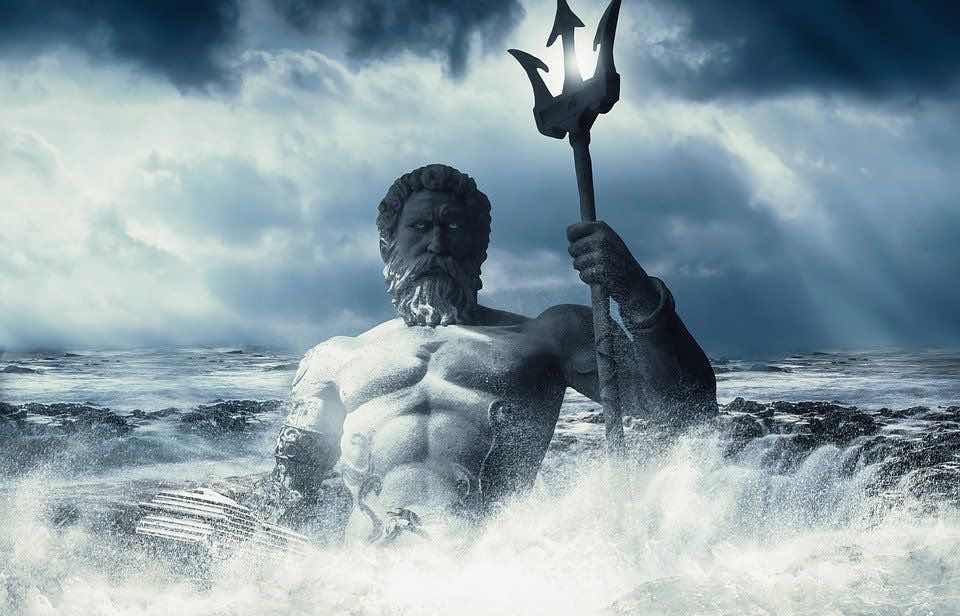
Cronus married Rhea, another Titan, and together they had five children, who also became Gods: Demeter, Hestia, Hera, Hades, and Poseidon. Like Ouranos, Cronus feared that his children might one day overthrow him. So each time Rhea gave birth, Cronus would then swallow the newborn God. However, since Gods are immortal, they did not die, but continued to grow inside of Cronus.
Determined to protect her sixth child from his father, Rhea gave birth in SECRET. She named the infant Zeus and sent him to the island of Crete, to be raised by nymphs. Then, pretending to obey her husband's cruel command that she surrender all their children to him, Rhea wrapped a heavy stone in a baby blanket and carried it to Cronus, who swallowed the stone without any notice.
As the young god Zeus matured, he became more and more powerful. When Rhea, thought him mighty enough to challenge Cronus, she told him about his five brothers and sisters trapped inside their father's body, and about how narrowly he had escaped the same fate.
With the help of his Grandmother Gaea, Zeus forced his father to regurgitate his five brothers and sisters, as well as the stone. The stone was taken to Delphi and left there. What Cronus feared all along became a reality. His children, who were led by their youngest brother, Zeus, waged war against him. However, Cronus was not left defenseless, he was backed by most of his brothers and sisters, the Titans.
The war between the Gods and the Titans was so terrible that it nearly destroyed the universe. The Titan Prometheus, whose name means "forethought," could see that Zeus and his siblings were destined to win this war against Cronus, so he abandoned his own brothers and sisters and joined the other team.
He secretly advised Zeus to release Gaea's first-born children, the Hundred-Handed Ones, informing him that they wielded thunder, lightning, and earthquakes as weapons. Once released, the monsters fought much harder against Cronus because he had betrayed his earlier promise to free them.
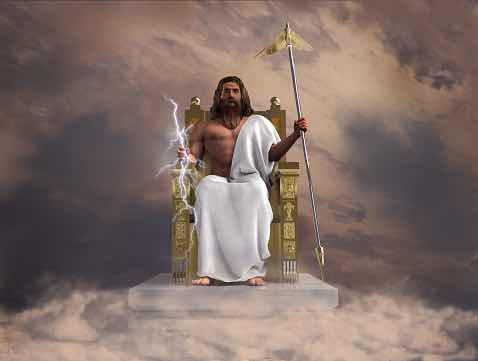
With the help of Prometheus and the monsters, the gods finally defeated the Titans. Cronus and his relations were then imprisoned at Tartarus, the deep bowels of the earth. Zeus, impressed by the effectiveness of the monsters' weapons, appropriated the thunder and lightning for his own use. From that time on, whenever Zeus grew angry, he hurled thunderbolts at the target of his rage.
With the entire world open to them after the war, the Gods chose the cloud-draped summit of Mt. Olympus to be their home. The only Titans who were welcomed into the counsel of the Olympian gods was Prometheus, who's advice had ensured their victory, and his brother Epimetheus, as a favour to Prometheus. Prometheus preferred to keep Epimetheus near him, because Epimetheus, whose name means "afterthought," lacked wisdom and commons sense.
Zeus assigned Epimetheus and Prometheus the task of populating the earth with mortal creatures. With that task, Epimetheus thoughtlessly bestowed so many gifts on the lower animals that when the time came to create man, there was nothing left.
The beasts already had the sharp teeth and claws, the warm fur and feathers, the tough, protective hides, the wings and shells, and speed, size, and strength. Epimetheus turned to his wise brother for help in figuring out what gifts to bestow on man.
Prometheus gave man a more noble, upright stance, so man would be above the beasts, with his face turned toward the heavens rather then down toward the ground. He also gave man an intelligence that reached much higher than the beasts' mere cunning.
Prometheus was partial to these men he had created, and he was always thinking of ways to benefit them. As Prometheus became more biased, his gifts became more lavish. He took a torch up to the heavens and lit it from the fire of the sun. He gave man this gift of fire, the gift that made possible all of man's arts, and that also made it possible for man to conquer the cold and the dark. With power over fire, man was indirectly given the possibility to obtain seats near the Gods. Anger flourished when Zeus realized that Prometheus had stolen the sacred fire of the Gods and given it to mortals. Zeus then had him chained for all eternity to a rock in the Caucasus.
Though time, power, and control corrupted Zeus … he became weary that his sons would overthrow him, as he had overthrown his own father. He sent Hermes to ask Prometheus, who could see the future, which son would be his nemesis. Prometheus refused to reveal the secret, so Zeus found a way to make his punishment crueler. Everyday an eagle was sent to devour his liver, but every night the liver would grow back, making Prometheus's agony as eternal as his imprisonment.
His suffering lasted for many ages until, finally, he was freed through the good offices of Zeus's son Heracles, who begged his father to have mercy on Prometheus. Moved by Heracles's pleas, Zeus allowed his son to kill the eagle and to break Prometheus's chains. Thus Prometheus was freed at last.
During Prometheus's pain and suffering man was not left unpunished. Zeus commanded Hephaestus to fashion a woman out of clay. Up to that time, man had consisted entirely of males. So a woman named Pandora, meaning "all gifts," for she was endowed with every quality that would make her enticing and desirable. Zeus sent Pandora as a gift to Epimetheus, who gladly accepted the charming creature, even though Prometheus had warned him that Zeus was their enemy and they must never accept any gifts from him.
Pandora brought with her a box that her maker had given her. She was warned that she must never, under any circumstances, open the box, which piqued her curiosity. The day came where she could no longer bear the mystery of the box. She carefully lifted the lid. To her dismay, all sorts of hideous winged creatures came flying out of the box so fast that she could not shut the lid, the last of them escaping. Preconceiving that Pandora would eventually succumb to curiosity, all knowing Zeus packaged the box with every sort of physical and spiritual ill he could devise. Therefore, Plague, Famine, Misery, Despair, Hatred, Warfare, and many other forms of suffering escaped into a world.
After Pandora had slammed the lid shut, she heard a small fluttering sound from inside the box. Her curiosity arousing once more, lifting the lid once more, a small, delicate creature with golden wings flew out; its name was Hope.
And that, was how the Ancient Greeks explained the process of creation and how the world came into existence. Each civilization had their own unique myths of how the world came into existence. Ultimately, they all got meshed together across multi-civilizations and mythical fables and allegories. So, until we can really figure it out, my suggestion is that we enjoy our time here in this incarnation, be kind to others, spread love and compassion among humanity.
Just a thought ...
~Justin Taylor, ORDM.