Showing posts with label HEAVEN. Show all posts

13 May 2022

WHICH ART IN HEAVEN

WHICH ART IN HEAVEN

Before we delve into this topic, first let's look at the New Testament Christian Bible Book of Luke 11, and Book of Matthew 6; for the offering of the Lords Prayer:

The Lord's Prayer (King James Version)

"And when thou prayest, thou shalt not be as the hypocrites are: for they love to pray standing in the synagogues and in the corners of the streets, that they may be seen of men. Verily I say unto you, They have their reward.

But thou, when thou prayest, enter into thy closet, and when thou hast shut thy door, pray to thy Father WHICH is in secret; and thy Father WHICH seeth in secret shall reward thee openly.

But when ye pray, use not vain repetitions, as the heathen do: for they think that they shall be heard for their much speaking. Be not ye therefore like unto them: for your Father knoweth what things ye have need of, before ye ask him.

After this manner therefore pray ye: 

'Our Father WHICH art in heaven, Hallowed be thy name.
Thy kingdom come, Thy will be done in earth, as it is in heaven.
Give us this day our daily bread.
And forgive us our debts, as we forgive our debtors.
And lead us not into temptation, but deliver us from evil: For thine is the kingdom, and the power, and the glory, for ever. Amen.'"

Now, the King James Version of the Bible uses the word "which," rather than the many other translations that have chosen to use the word "who," or in some cases omit it all together. For example, in the Matthew 6:9 text, we have the following examples from various translations:

Our Father in heaven ... 
Our Father in the heavens ... 
Our Father, who is in heaven ...
Our Father who art in heaven ... 
Our Father who are in heaven ... 
Our Father who is in the heavens ... 

If you've made it this far, you're probably wondering "so what?" Is this just semantics or what? Grammar is an important element of translation, particularly from one language to another. In this particular case, we should look hard at the usage of "which" when referencing the "Our Father WHICH art in heaven." 

Proper grammar usage dictates: "which" is for things, and "who" is for people. We don't use 'which' for people. We use 'who' or 'that' for people. Further, we use 'which' or 'that' for things. We use relative clauses to make clear which person or thing we are talking about. 

Knowing this, the reference to "our Father," is a reference to a thing. Hence, the use of which. Thing you say? Yes. This "thing" is the indwelling Spirit within ALL of Life. The animating Source of all that is. The Life-force that IS God within. The Spirit of animation. This is the thing WHICH art in heaven. The Hebrew word for heaven is "shamayim" and can be translated as lofty, above, beyond. The Greek word is "ouranos" and can be translated as universe, world, sky, upper regions, encompass, high place, seat of order of things eternal. 

The Bible states: "And then Jesus said when they asked him, ‘Where is the kingdom of heaven and when is it going to come?’ he said, ‘The kingdom of heaven does not come with signs to be perceived. You cannot say, ah, it’s over here or look, it’s over there, for I tell you the kingdom of heaven is within you.’” When Jesus says “it is within you,” he is also quoting Moses from the Old Testament Book of Deuteronomy:

"‘Who will cross the sea to get it and proclaim it to us so we may obey it?’ No, the word is very near you; it is in your mouth and in your heart (within you) so you may obey it.”
~Deuteronomy 30:11-14 

You may ask "is there a difference between Kingdom of God and Kingdom of Heaven?" The Kingdom of God, also called Kingdom Of Heaven, in Christianity, is the spiritual realm over which God reigns, or the fulfillment on Earth of God’s will. This phrase occurs frequently in the New Testament, primarily used by Jesus in the first three Gospels. He clearly points to within mankind as the dwelling place of the Spirit of God/Heaven.

Jesus said, “The Kingdom of Heaven is within you” (that is, here) and “at hand” (that is, now). It’s not later, but lighter ... a more subtle quality or dimension of experience accessible to you right in the moment. You don’t die into it; you awaken into it.

The Kingdom of Heaven is really a metaphor for a state of consciousness; it is not a place you go to, but a place you come from. It is a whole new way of looking at the world, a transformed awareness that literally turns this world into a different place. The hallmark of this awareness is that it sees no separation between God and humans, between humans and other humans. And these are indeed Jesus’s two core teachings, underlying everything he says and does.

When Jesus talks about this oneness, what he had in Mind is a complete, mutual indwelling: "I am in God, God is in you, you are in God, we are in each other." His most greatest symbol for this is in the teaching from John 15 where he says, “I am the vine; you are the branches. Abide in me as I in you." A few verses later he says, “As the Father has loved me, so I have loved you. Abide in my love." Again, there is no separation between humans and God because of this mutual interabiding which expresses the indivisible reality of Divine Love.

Also in Jesus’s teachings he says: “Love your neighbor as yourself” in Matthew 22:39 ... as a continuation of your very own being. It’s a complete seeing/showing that your neighbor is YOU. There are not TWO individuals out there. It is a community of ONE ... a common-unity of the one great Life. We are as individual rays of the sun, each containing the entirety of the whole, and yet not being the whole. The whole (holy) is a collective emanation, not a separate and individual consciousness. 

So as we return to the original message of God WHICH art in heaven, we now have a much better understanding that this "God" is not some bearded king enthroned in the clouds, but a Spirit that indwells all of Life. This Source of all that is, is experiencing Life through us, with us, and AS US. The sooner we come to the understanding that all are one, and that I am you and you are me, we will complete the creation and manifestation of "Heaven on Earth." The completed intersection of Spirit and matter (the cross). 

Just a thought ... 

Justin Taylor, ORDM. 


18 December 2021

STANDING ON SOLID GROUND

STANDING ON SOLID GROUND

The word ‘Earth’ came from the Anglo-Saxon word ‘erda’ and it’s germanic equivalent ‘erde’ which means ground or soil. Meanings include: the substance of the land surface; soil, the substance of the human body, the surface of the world as distinct from the sky or the sea.

Earth is the only planet name in our solar system that does not come from Greco-Roman mythology. All of the other planets were named after Greek and Roman gods and goddesses.

An important fact is that in Hebrew, the noun “adam” is also the masculine form of the word “adamah” which means “ground” or “earth (red clay).” It is related to the words: adom (red), admoni (ruddy), and dam (blood).

Every civilization has had their way of describing where or what may have sparked all of creation. When we reference the creation account described allegorically in Genesis we find:

Genesis 1:1 - “In the beginning God created heaven, and earth.” 

This is best translated as spirit and matter … the unseen and the seen. 

Now, look at “heaven” not just as an unseen state within, but as a celestial abode. Ancient cosmology played an important role in the cycles of life and the divine patterns and forms.

The first planet discovered that was not known in ancient times, named for the god of Heaven, husband of Gaia, the Earth, from Latin Uranus, from Greek Ouranos literally "heaven, the sky;" in Greek cosmology, the god who personifies the heavens, father of the titans. 

The ancients believed that the Spirit beings or Gods and Angels lived in the unseen realms, the ancients usually called “heaven” and “hell,” which are more accurately described as being "in" or "out" of God's direct presence. Within, and without. Above, and below. 

So, in closing; our physical bodies are our spiritual “ helpmate.” In Genesis 2:18 we read “It is not good for the man (mind/mankind) to be alone, I do make to him an helper … as his counterpart.”

We come from the Earth/matter (Mother Earth) and from Spirit/heaven (Father). 

Our Spirit grows through our experiences here in Earth (matter/soil). This is Earth School, and we’re in class every moment of every day. 

Just a thought … 

Justin Taylor, ORDM.


23 February 2021

SYMBOLS OF CHRIST AND NEPTUNE

SYMBOLS OF CHRIST AND NEPTUNE (POSEIDON)

Symbols of Christ and Neptune (Poseidon) 

Lord of Pisces
Sign of the Fish
Wine
Sacrifice and Holiness

All ancient faiths and beliefs, with no exception, were based on the oldest science, astrology - the influence of the planets. The planets were representative of the gods in ancient Greece and Rome, Egypt and Babylon, India, and virtually all over the inhabited world. Our current world faiths originated in the very same ancient world. It should not be a surprise to find they are also all based on astrology, all recognizing One God/Source of all things (Astrotheology).

The Christ is a portrait of the great Neptune, the higher, Divine dimension of this Spirit, beyond the personal astrology of the horoscope. This recognition, based on the Kabbalah, gives us the rational, credible, scientific and multi-faith/Interfaith understanding of God/Source that we need in modern times. It strongly supports the esoteric allegorical/metaphorical message of the Bible, especially the Synoptic Gospels - the message of love and peace - but avoids the literal and historical exoteric interpretation and presentation.

The “Tree of Life” symbol (search the Internet for a graphic) is the basis of the Kabbalah, the esoteric tradition behind the Bible. The Tree is quite clearly an astrological map of the solar system with all the planets and Signs of the zodiac. This tree was, and is also followed by the Gnostics.

The Tree of Life reveals the astrology/astrotheology and cosmogony at the heart of the biblical tradition, beginning with Genesis 3.22 and continuing all the way to to Revelation 22.2, where its astrological character is confirmed, as to its role within ancient and modern Christianity. “The Tree of Life which bare twelve manner of fruit (the twelve Signs) and yielded her fruit every month.” This references the monthly cycle of the moon through the Zodiac. This is the annual precession of the Sun and moon through it's cycles and seasons.

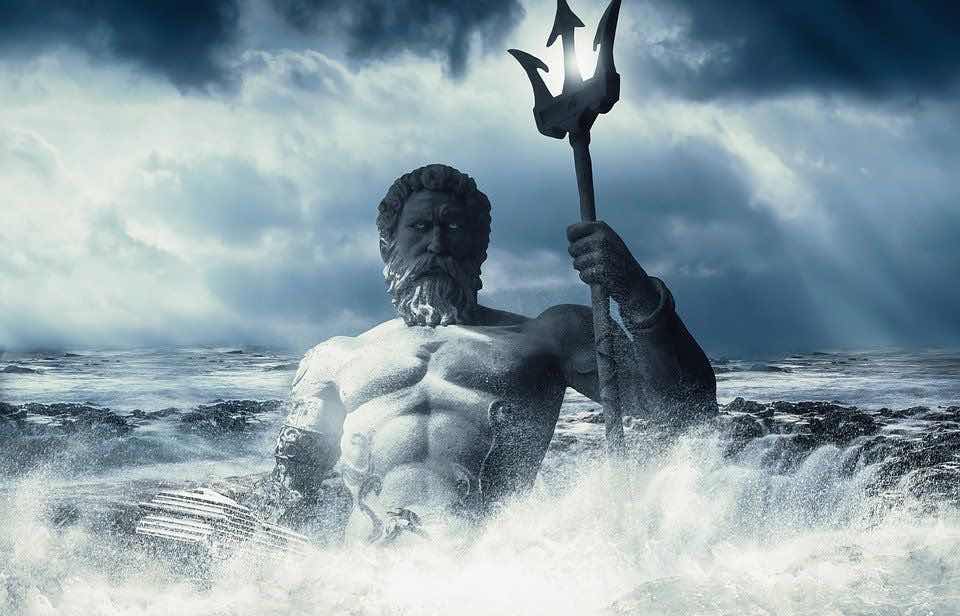
Neptune rules the Sign of the Fish (Ichthus), the Traditional symbol of Christianity. Neptune is identified with wine, holiness, suffering, sacrifice and Pisces (Vesica Pisces), the age of Christianity. Neptune was the god of the fish and the seas, and Christ is constantly associated with the Sea of Galilee and fish. He guides his fishermen disciples to a miraculous catch, walks on the water and calms a violent storm.

Jesus The Christ is repeatedly ‘the true vine’ and the “lord of the vineyard.” Wine is the special sacrament, symbolizing within Christianity, his blood. Many more Kabbalah images throughout the Gospels confirm this identification. Far too much to cover for this one writing, but we will go into other details at another time. Remember also, that Neptune/Poseidon (Latin/Greek) had a weapon of choice ... the “Trident.” In Hindu Myth, it was the weapon of Shiva and was called “Trushula,” which is Sanskrit for “triple-spear.” This in many ways is representative of a Trinity. In Hindu, it represents Deity in three aspects: Creator, Preserver, and Destroyer. The Trident was symbolic among many ancient civilizations and myths. 

In religious Taoism, the trident represents the Taoist Trinity, the Three Pure Ones. In Taoist rituals, a trident bell is used to invite the presence of deities and summon spirits, as the trident signifies the highest authority of Heaven. Both Poseidon's trident and Zeus' thunderbolt were originally a sacred labrys, but later distinguished from each other when Poseidon became god of the sea, while Zeus claimed the right to the thunderbolt. 

Spiritually, Planet Neptune is most closely linked with the work of the Soul in manifestation and is the vehicle for the Christ consciousness, which is at the Heart of Divinity. On the personal level, the indwelling Christ Principle is our Soul - more particularly, that aspect of the Soul which is Love. The Divine Spark of God. It is this facet of our self that we pray to and evoke for healing, nurturing and spiritual sustenance. Collectively, it is the indwelling Christ Principle in humanity which, when evoked, brings forth these healing properties from mankind. In the New Testament, Jesus defines “Love, Peace, and Joy” as the Kingdom of Heaven/God. 

All the Universe is contained not just without, but WITHIN. This was the message of The Christ. In the Book of John 14;9 we are reminded: “... he that hath seen me, hath seen the Father.” The microcosm/macrocosm refers to the structural similarity between the human being (the microcosm: the small order or the small Universe) and the cosmos as a whole (the macrocosm: the Great Universe). Given this spiritual analogy, the Truths about the nature of the cosmos as a whole, can further explain the Truths about human nature, and vice versa. 

Just a thought ... 

Justin Taylor, ORDM.